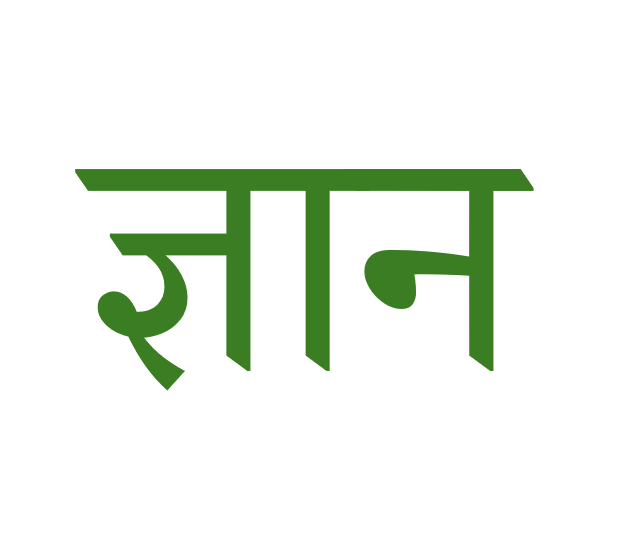
In Sanskrit, ज्ञ jña is a consonant conjunct formed from the palatals ज् j + ञ ña, yielding ज्ञ jña. The pronunciation of this conjunct has undergone significant change over time and across regions. This shift had already begun in the Middle Indo-Aryan period (Pali, Prakrits, Apabhraṁśa).

For example:

  • ज्ञान jñāna “knowledge” became ञाण ñāṇa in Pali.
  • आज्ञा ājñā “command, authority” became अञ्ञा aññā in Pali, meaning “authority / recognition.”

By regular sound change, ज्ञान jñāna in New Indo-Aryan languages would be expected to develop into forms like नाण nāṇa, as preserved in Old Gujarati નાણ nāṇa (tadbhava). However, many Sanskrit words were later re-borrowed into modern languages. Speakers, knowing the original conjunct ज्ञ jña, attempted to pronounce it according to the phonological rules of their own languages.

As a result, four major realizations of ज्ञ jña are found in India today:

  • Hindi and Nepali (and Sanskritic Bengali pronunciation): jña → gña → gya (ग्य)
  • Marathi and neighboring languages: jña → dña → dna (द्न)
  • Gujarati: gnya (ગ્ન્ય)
  • English approximation: nya

In Bengali, the conjunct জ্ঞ jña is retained in spelling but adapted in pronunciation, typically realized as a geminated or stop-based form rather than a true jñ cluster. For example ज्ञान jñāna is pronounced জ্ঞানে jñāne ≈ ggāne / gjāne, and আজ্ঞা ājñā as আগ্যা āggā / āgjā in educated speech. In Punjabi, the cluster is fully simplified both orthographically and phonetically, with jñ regularly resolving to gy. For example ज्ञान jñāna is typically borrowed as ਗਿਆਨ giān, with jñ → gy, while आज्ञा ājñā appears as ਆਗਿਆ āgiā “command, order.”

The behavior of ज्ञ jña in Dravidian languages further illustrates how strongly phonological constraints shape its realization. Classical Dravidian phonotactics do not permit complex consonant clusters such as . Consequently, Sanskrit loanwords containing ज्ञ jña were adapted through simplification or reinterpretation.

In Tamil, which entirely lacks consonant clusters, ज्ञ jña is regularly reduced to ஞ ñ, often with compensatory lengthening or gemination. Thus ज्ञान jñāna becomes ஞானம் ñāṉam, and आज्ञा ājñā appears as ஆணை āṇai “command,” showing complete restructuring rather than phonetic preservation.

In Kannada, Telugu, and Malayalam, Sanskrit loans often preserve the orthographic conjunct ಜ್ಞ / జ్ఞ / ജ്ഞ, but this reflects learned spelling rather than spoken reality. In actual pronunciation, is commonly realized as ññ, gy, or simply ñ, depending on the language and register. For example, ज्ञान jñāna is frequently pronounced as ñāna or gyāna, and आज्ञा ājñā as āṇe / ājñe / āñā.

These Dravidian adaptations parallel developments seen in Middle Indo-Aryan, though they arise independently. In both cases, the complex palatal conjunct jña is resolved in ways that conform to the native phonological system, demonstrating that the modern diversity of pronunciations of ज्ञ jña across the Indian subcontinent is driven less by Sanskrit phonology itself and more by the constraints of recipient languages.

Thus, the divergent modern realizations of ज्ञ jña across Indo-Aryan and Dravidian languages reflect not the preservation of Sanskrit phonology, but systematic adaptation to the phonotactic constraints of recipient languages. Together, these developments show how a single Sanskrit conjunct has generated a wide range of outcomes through regular sound change, borrowing, and learned reintroduction.

References:

Masica, C. P. (1991). The Indo-Aryan languages. Cambridge University Press.

Kapadia, H. R. (1935). A NOTE ON KṢA AND JÑA. Annals of the Bhandarkar Oriental Research Institute, 17(3), 289–296.

Burrow, T. (1946). The Sanskrit loan-words in Tamil. Bulletin of the School of Oriental and African Studies, 11(4), 799–808. 

Burrow, T., & Emeneau, M. B. (1984). A Dravidian etymological dictionary (2nd rev. ed.). Oxford University Press.

Kittel, F. (1903). A grammar of the Kannada language. Basel Mission Press.

Krishnamurti, B. (2003). The Dravidian languages. Cambridge University Press. 

Norman, K. R. (1991). Middle Indo-Aryan and Dravidian. In O. von Hinüber & K. R. Norman (Eds.), Collected papers (Vol. 2, pp. 255–270). Pali Text Society.

Zvelebil, K. (1973). The smile of Murugan: On Tamil literature of South India. E. J. Brill.


Discover more from Linguistica Indica

Subscribe to get the latest posts sent to your email.