Written by A. Avtans
[This article is copyrighted, please mention author’s name with article’s title while you are copying/referring content from this page].
Updated: 17 Dec 2025
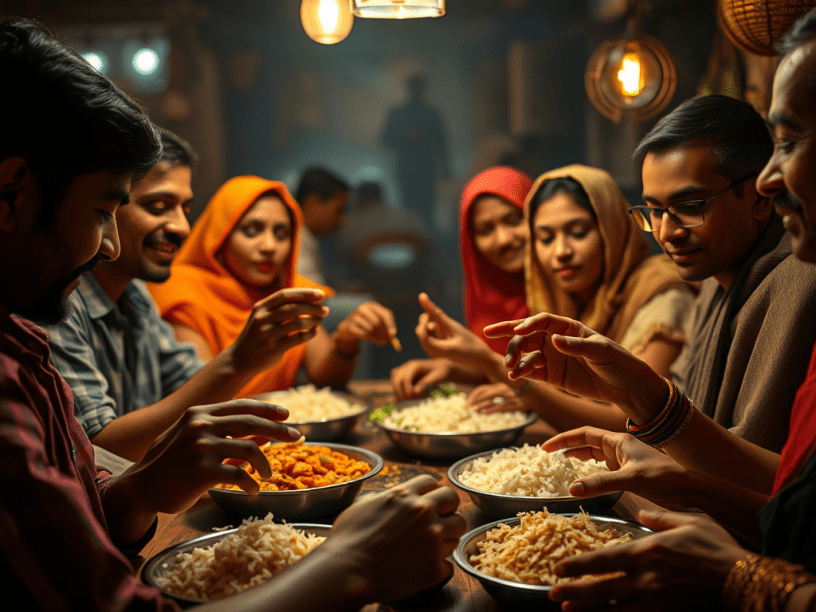
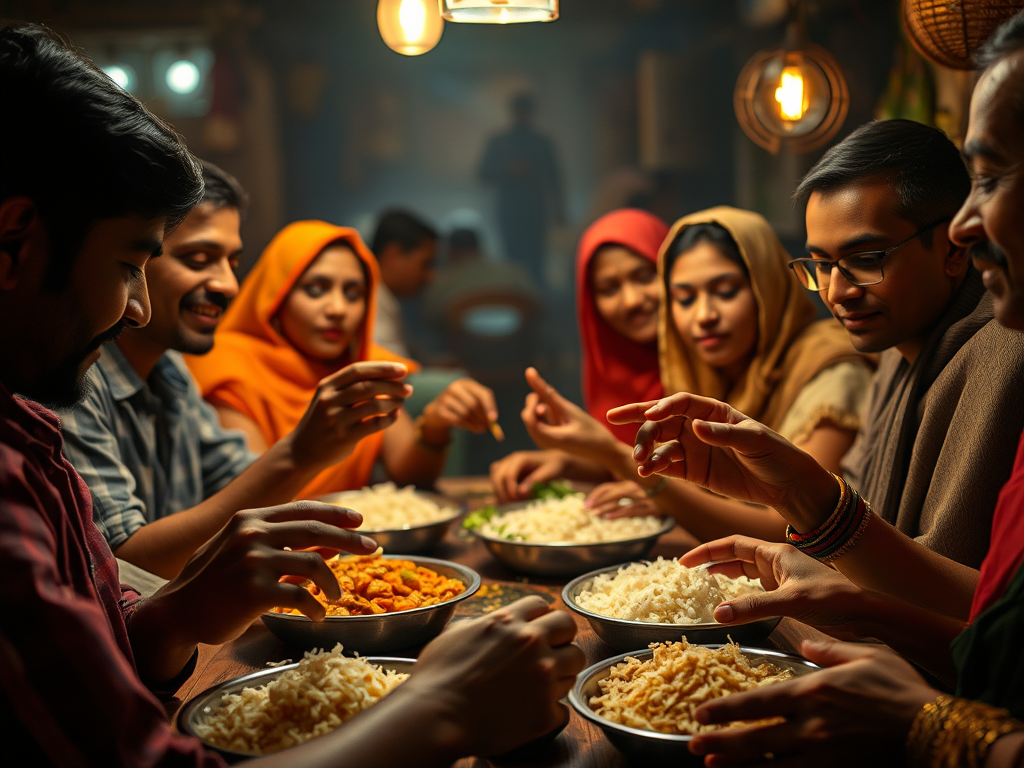
While watching Wong Kar-wai’s Chungking Express (1994), a particular scene lingered in my mind far longer than expected. The film, set against the rhythms of everyday life in Hong Kong, briefly turns its attention to a group of Pakistani immigrant men sharing a meal in a dimly lit room. The camera does not focus on their faces; instead, it moves across their hands as they touch rice, bread, and curry, accompanied by faint background chatter in Hindi/Urdu. The scene then cuts to a Chinese food-joint owner who remarks on how uncouth it is to eat with one’s hands when chopsticks are available. This moment prompted me to reflect on why societies develop such strong notions of being more “civilized” by maintaining distance between one’s fingers and food.
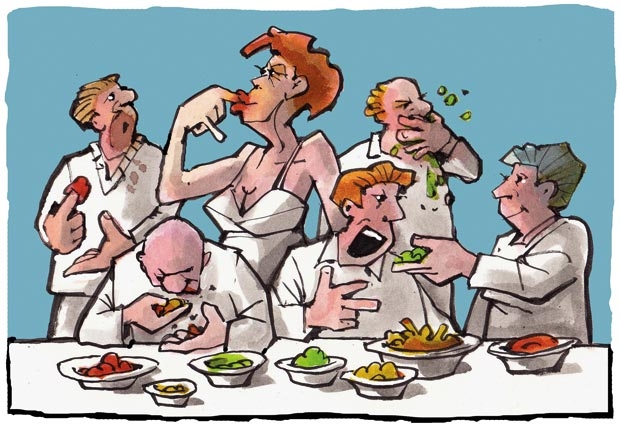
In Chinese culture, eating with bare hands is often considered uncouth or uncivilized. A similar attitude can be found in Indonesia, where eating with bare hands is generally regarded as improper, as spoons are the norm. Yet among the Javanese in Indonesia, eating with bare hands is common and culturally accepted, even valued. In the Philippines, eating with bare hands is widespread and is often celebrated as a national trait. These examples already suggest that ideas of propriety in eating are neither universal nor fixed, but deeply shaped by cultural context.

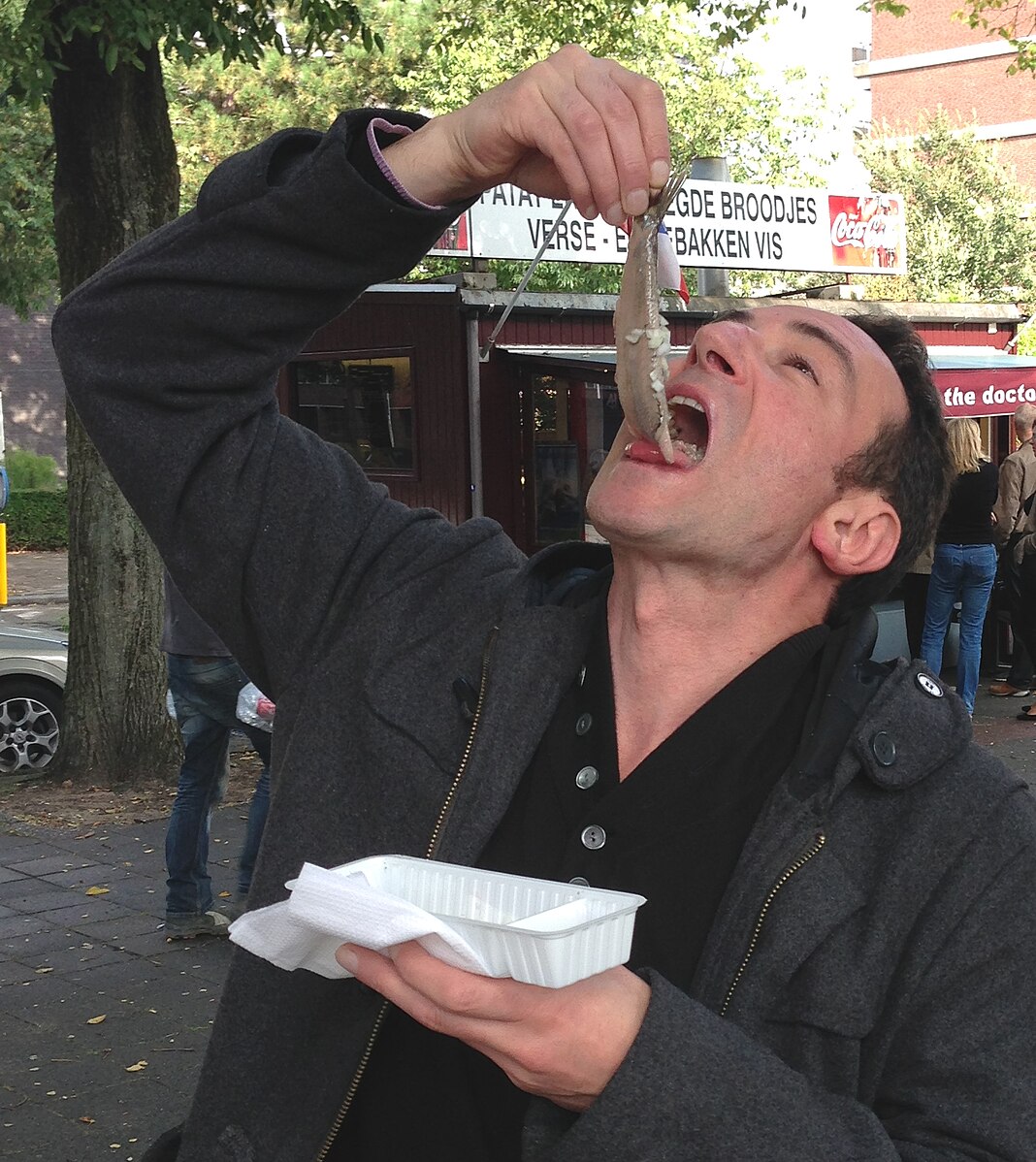
Western Europeans, for instance, often find the Chinese style of eating, holding a bowl of rice or noodles close to the mouth and eating with quick-moving chopsticks, accompanied by slurping sounds, messy or even disgusting. Complaints about noise and lack of refinement frequently accompany such judgments. What is perceived as uncouth here, however, is understood within Chinese culture as normal, efficient, and even respectful towards food. When compared to the Dutch practice of eating raw herring by holding it and lowering it directly into the mouth, this act may evoke a sense of revulsion in some observers.
Communities in the Indian subcontinent, on the other hand, have their own complex and sometimes contradictory ideas about what constitutes cultured or civilized eating, particularly when eating with bare hands. Traditionally, South Asians eat with their hands, and a strong distinction is made between the right and left hand, with the left hand regarded as unclean and the right hand is the eating hand. Yet within this shared framework, eating practices vary significantly across regions.
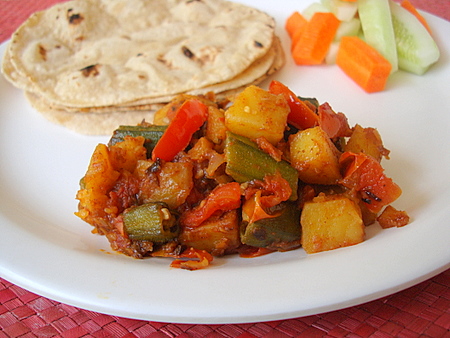
Moving from the far north of India toward the south, one encounters a relatively uniform pattern of changing eating manners. In the far north, among many people from Haryana, Punjab, western Uttar Pradesh, and Rajasthan, there is pride in a particular way of eating with bare hands. The general principle is to avoid touching curry or soup directly with the fingers. Roti is torn into small pieces and shaped into a spoon-like form, which is then used to scoop up the curry before placing it in the mouth. In this manner, contact between fingers and liquid food is minimized. An interesting consequence of this practice is that washing hands after eating becomes almost unnecessary; a brief rubbing of the palms to remove crumbs often suffices, and one can immediately return to other activities. Notably, the bread itself may be broken using both hands, including the so-called unclean left hand.
In central India and in the eastern and western regions, such as Madhya Pradesh, eastern Uttar Pradesh, Bihar, Jharkhand, Odisha, Bengal, and Assam in the east, and Gujarat and Maharashtra in the west, eating practices differ noticeably. People in these regions generally dip all five fingers of the right hand into curry or soup while eating rice or roti. Fingers are often licked clean when consuming liquid or semi-liquid food. Here, the concern is not avoiding contact with curry altogether, but ensuring that the back of the palm, wrist, or lower arm does not come into contact with it. Washing hands thoroughly after eating is considered necessary, as is washing them beforehand.
In northeastern India, among communities in Assam, Nagaland, Manipur, Meghalaya, Mizoram, and Tripura, curries and rice have traditionally been eaten with bare hands. However, due to proliferation of western education and under the influence of Christian missionaries, younger generations increasingly use spoons and forks. Older people, by contrast, often continue to eat with their hands, maintaining long-established practices.

In the far south of India, including Tamil Nadu, Karnataka, Andhra Pradesh, Telangana, and Kerala, eating with bare hands becomes a more passionate and immersive affair. Curries and rice or breads are eaten freely with the hands, and it is entirely acceptable for food to touch the back of the palm or even the lower half of the arm. Slurping food and licking curry from the back of the hand are considered integral to eating with satisfaction and joy. Consequently, not only the hands but also the lower arms require thorough washing after the meal.
These regional variations reveal how ideas of good or civilized eating habits are often shaped by local norms and are frequently used to judge others. In India, far northerners often take pride in their manner of eating and ridicule other practices by using labels such as “Bihari” or “Madrasi.” People from central and eastern regions may describe southern eating styles as messy or unhygienic, while southerners often celebrate their own practices and view eating with spoons and forks as an uncultured or overly westernized influence. In the Malayalam film Rasam (2015), Mohanlal is seen celebrating the act of eating with bare hands, as he teaches his Qatari guests how to use their fingers to eat the delicious food served to them.
Returning to the question raised by Chungking Express, it becomes difficult to determine which mode of eating, using chopsticks, forks, or bare hands, can truly be described as more civilized. Rather than pointing toward a clear hierarchy of refinement, these diverse practices suggest that ideas of civility and hygiene are deeply relative, culturally produced, and constantly negotiated through everyday acts such as eating.
Discover more from Linguistica Indica
Subscribe to get the latest posts sent to your email.
 Linguistica Indica
As a Kannadiga (from Karnataka), I love eating with my hands. Sure, it involves having to wash your hands, but food tastes so much better! Glad to see you took a very unbiased view point and represented all the habits just as they are.
@ asympotically
Thanks for reading ! Ya I totally understand your point. We have to educate people not to discriminate on the basis of how someone eats!